<?xml version="1.0" encoding="utf-8"?><feed xmlns="http://www.w3.org/2005/Atom" ><generator uri="https://jekyllrb.com/" version="4.0.1">Jekyll</generator><link href="https://dmonn.com/feed.xml" rel="self" type="application/atom+xml" /><link href="https://dmonn.com/" rel="alternate" type="text/html" /><updated>2026-07-15T13:18:59+00:00</updated><id>https://dmonn.com/feed.xml</id><title type="html">Dominic Monn</title><entry><title type="html">Selling to the assistant</title><link href="https://dmonn.com/selling-to-the-assistant/" rel="alternate" type="text/html" title="Selling to the assistant" /><published>2026-07-07T05:34:28+00:00</published><updated>2026-07-07T05:34:28+00:00</updated><id>https://dmonn.com/selling-to-the-assistant</id><content type="html" xml:base="https://dmonn.com/selling-to-the-assistant/"><![CDATA[<p>For a long time, buying something online still involved a surprising amount of manual labor and human decision-making.</p>

<p>You had to understand the category well enough to know what to search for. You had to work out which sources to trust. You had to translate your requirements into filters and keywords that a search engine could grasp. Only after that did you arrive at the vendor’s website, where the company finally got its chance to explain why it was the right choice.</p>

<p>If you hit a dead end, you had to get human support. Maybe a family member who knew the space, or a new thread on Reddit.</p>

<p>Not a smooth process, but a human one. Once you landed on that website, a company could still make its case. You might choose an inferior product on paper in order to support a smaller team, or go with a brand that simply looked more polished.</p>

<p>As of 2026, that journey is changing quickly.</p>

<h2 id="blind-trust">Blind trust</h2>

<p>At <a href="https://mentorcruise.com?ref=dmonn">MentorCruise</a>, this has become visible in the numbers.</p>

<p>A year or two ago, our buying journey looked like a normal marketplace journey. More than 65% of people found us through search engines. Some came through word of mouth, reviews, comparison pages, or competitors. When they landed on the site, they used a traditional marketplace interface: profile cards, categories, search, filters, reviews, pricing, availability.</p>

<p>Before booking a mentor, people would save half a dozen profiles, compare them across tabs, sometimes get second thoughts, and look up our reviews on third-party websites. You could see this in site analytics as people jumped from A to B to C and back to A.</p>

<p>That journey is no longer the default.</p>

<p>Today, more than 36% of our users find us through ChatGPT and other AI assistants. Only 30% of users still report going through the old search engine path.</p>

<iframe src="https://www.linkedin.com/embed/feed/update/urn:li:share:7473594287553671169?collapsed=1" height="670" width="504" frameborder="0" allowfullscreen="" title="Embedded post"></iframe>

<p>It is tempting to read this as just a change in referrer. I do not think that is right. It changes the state of the buyer when they arrive.</p>

<p>A <strong>search visitor</strong> arrives with an open question and a need for information.</p>

<p>An <strong>AI-referred visitor</strong> often arrives with a formed recommendation. They may already know your competition, how you compare, and what people say about you online.</p>

<p>They have already asked something like: “I need help moving into product management” or “I’m stuck in my engineering career.” They may have refined the search with constraints like “I’ve already tried this bootcamp” or “My budget does not allow me to take a full certificate course.”</p>

<p>The assistant explains the category, compares possible paths, and sometimes recommends us. By the time the person reaches MentorCruise, part of the selling has already happened somewhere else.</p>

<p>That is useful when the assistant gets it right. It is dangerous when it does not.</p>

<h2 id="the-sale-before-the-visit">The sale before the visit</h2>

<p>The website is no longer guaranteed to be the first serious sales surface. For a growing slice of users, the website is where they go after the important part of the decision has already been shaped.</p>

<p><a href="https://blog.adobe.com/en/publish/2025/03/17/adobe-analytics-traffic-to-us-retail-websites-from-generative-ai-sources-jumps-1200-percent">Adobe Analytics</a> saw traffic from generative AI sources to U.S. retail sites rise 12x in February 2025 compared with July 2024. Adobe also found that 39% of surveyed U.S. consumers had used AI for online shopping, especially for research, deals, gift ideas, and shopping lists.</p>

<p>Adobe also found that AI-referred visitors were more engaged, viewed more pages, and bounced less than non-AI traffic. That matches what I see in our own data.</p>

<p>For most categories, AI is not yet replacing the transaction. But it is starting to replace the entire path leading up to it: the part where people figure out what they want, form a shortlist, and research the company behind it.</p>

<h2 id="flying-blind">Flying blind</h2>

<p>This also creates a measurement and attribution problem.</p>

<p>Assistants are shaky in adding consistent tracking to their links, and in many cases strip or omit tracking and referrer data entirely. These clicks can show up the same way as someone who typed your URL directly into the address bar.</p>

<p>A user might ask ChatGPT for the best way to find a mentor, get recommended MentorCruise, search the brand name on Google, click the organic result, and sign up.</p>

<p>Analytics may call that organic search. But Google did not create the intent. It captured the navigation.</p>

<p>A 2026 paper called “<a href="https://arxiv.org/abs/2606.10907?utm_source=chatgpt.com">From Prompt to Purchase</a>” studied opt-in clickstream data connected to users’ ChatGPT, Claude, and Gemini conversations. The authors found that when an assistant recommended a brand to a user with no recent observed engagement, same-name Google searches, brand-site visits, and brand-specific retailer-page visits all increased.</p>

<p>This is probably already happening to many companies, and marketing teams are missing it.</p>

<h2 id="answering-differently">Answering differently</h2>

<p>The same shift is happening once users arrive.</p>

<p>When people come to <a href="https://mentorcruise.com/match/?ref=dmonn">MentorCruise</a>, many no longer want to browse through dozens of profiles. They do not want to learn how the platform works. They want to describe their situation and be guided.</p>

<p>So our own assistant now helps users clarify their goals, find relevant mentors, and write a better first message. That means a person can go from “I think I need help” to “I reached out to this specific expert with a clear goal” while mostly talking to software.</p>

<p>The first human conversation might be the intro call with one of our mentors.</p>

<p>The product we sell is still deeply human. People come to MentorCruise because AI alone is not enough. They want judgment, accountability, lived experience, and someone who has actually done the thing.</p>

<p>But the path to that human relationship is becoming less human.</p>

<p>For the last twenty years, online businesses optimized to be found by humans through machines: search, ads, social, affiliates, review sites, marketplaces.</p>

<p>Now businesses need to be legible to machines acting on behalf of humans.</p>

<ul>
  <li>Can the assistant understand what you do?</li>
  <li>Can it explain when you are the right choice?</li>
  <li>Can it compare you correctly against alternatives?</li>
  <li>Can it access your inventory, pricing, availability, reviews, and outcomes?</li>
  <li>Can it take a useful next step for the user?</li>
</ul>

<p>There is a good version of this future.</p>

<p>A user gets a better answer. Less affiliate spam. Fewer generic SEO blog posts. In that version, the assistant is a better buying interface.</p>

<p>But it is hard to believe this layer stays neutral forever.</p>

<p>If assistants become the place where commercial intent is formed, <a href="https://ads.openai.com/">companies will try to influence them</a>. And the companies operating those assistants will have obvious reasons to monetize that influence.</p>

<p>Maybe it will not look like classic search ads. It may be called preferred merchants, verified providers, sponsored recommendations, partner integrations, instant checkout eligibility, or something else.</p>

<p>The assistant that helps you decide what to buy is sitting very close to the transaction.</p>

<p>That is valuable.</p>]]></content><author><name></name></author><summary type="html"><![CDATA[Buying used to be a human process of searching, comparing, filtering, and deciding. As more customers arrive through AI assistants, the sale increasingly happens before they ever reach your website.]]></summary></entry><entry><title type="html">How to build a support org</title><link href="https://dmonn.com/how-to-build-a-support-org/" rel="alternate" type="text/html" title="How to build a support org" /><published>2025-11-12T21:10:06+00:00</published><updated>2025-11-12T21:10:06+00:00</updated><id>https://dmonn.com/how-to-build-a-support-org</id><content type="html" xml:base="https://dmonn.com/how-to-build-a-support-org/"><![CDATA[<p>I was at breakfast with a fellow founder this week. They’re doing well – good growth, interesting product, maybe even something that you can call product-market fit. And yet, they were unhappy with how things were going.</p>

<p>They went from happily building an incredible product to spending up to 4 hours per day in emails solving customer queries. Pressure from the user base was mounting, and in return this collapsed any innovation that could be done on the product.</p>

<p>It’s not a story I hear for the first time. Just two weeks ago, another founder shared the same story over coffee. Two months ago I heard the exact same thing meeting a founder in Japan over lunch. Their companies have so little in common, basically only the fact that they have an SMB user base – more customers paying less per account than in enterprise – and they were all fairly early-stage, growing quickly.</p>

<p>It made me think how come I don’t relate to these issues? And it made me recall the journey we’ve taken with customer support at <a href="https://mentorcruise.com/">MentorCruise</a>, bringing it to a place where our support org handles thousands of inquiries every month with ease.</p>

<h2 id="how-i-spent-50-of-my-revenue-on-my-first-employee">How I spent 50% of my revenue on my first employee</h2>

<p>It was summer of 2020, and my company had just experienced its very first growth spurt. I had been building and refining for the better part of the past two years, and due to <em>unforeseen global circumstances</em>, revenue had suddenly scaled 400% in just a couple of months.</p>

<p>It’s not that customer support started to grow beyond what I could handle, but holding down a full-time job and wanting to develop the product further, I definitely had other priorities stacked higher. So I took a leap, and hired my first employee – customer support.</p>

<p>At the time, this was painful. What founders often don’t consider is how much of the history, context, and knowledge of a product really just lives within the containment of your own brain. And when a second person gets added to the team, all of this needs to be shared.</p>

<p>So our workflow for the first few months was as follows:</p>

<ul>
  <li>
    <p>A customer would send in an email</p>
  </li>
  <li>
    <p>My customer supporter would consult docs and a test version of our product trying to answer it</p>
  </li>
  <li>
    <p>If they could, they’d write it down</p>
  </li>
  <li>
    <p>If they couldn’t, they’d ask me</p>
  </li>
  <li>
    <p>I would then tell them how, and document our approach, write a policy, or similar</p>
  </li>
</ul>

<p>In the first week I still replied to 90% of the emails. Then a few less, then a few less, until I was only consulted on edge cases and company-defining cases.</p>

<h2 id="the-three-level-system">The three-level system</h2>

<p>When I was first studying software engineering, our school put a mandatory customer support course in our curriculum: “three-level support”. It was essentially free credits, and a course I thought I’d be able to forget the second I walked out of it.</p>

<p>And yet, as our team grew, I found myself being drawn back to it.</p>

<p>The system is pretty simple. A support request can be escalated up to three levels. The first level is general support. It’s all those inquiries that can be answered by anyone reading the help articles or docs, but just choose not to. The first level can often be fully replaced by AI these days – but I’m going to talk about this later. New supporters can be onboarded at this level in a day or two.</p>

<p>Second-level support is technical support. This requires access to your systems and billing. For most companies, this is going to be the same person as in first-level support, but in some cases this might be tickets getting through the AI system, or a more senior supporter taking over a ticket from a new hire. This takes a bit of training and trust with access to your systems, as they’ll solve any issues that require system actions – blocked users, refunds, data inconsistencies, etc.</p>

<p>The third, and last level of support, is the expert support. At the early stages, this is likely you – as the founder. Later on this might be a marketer, developer, or admin. At this point, something is very wrong and requires your action. Maybe it’s as simple as a small bug or hole in your refund policy. Sometimes it’s something that needs a couple of days to be ironed out. That’s why the expert needs to take over.</p>

<p>The approach to consult me whenever something was unclear or needed further action didn’t scale, and so we adopted the three-level support system with the first two levels covered by the customer supporter.</p>

<h2 id="expectations-are-growing-and-youre-doing-worse">Expectations are growing, and you’re doing worse</h2>

<p>Even though it feels like a fairly static topic, customer support has evolved a lot since my first dive into it in 2020. Recent examples like fully configured AI agents come to mind, but the changes have been happening for the better part of the past decade.</p>

<p>First, my experiences with customer support only cover the email route. In the last couple of years, however, more customers have come to expect a live chat to be present, and answers to be almost instantaneous.</p>

<p>AI can take some of that heat off you, but all founders I’ve talked with who have explored such a system have had to backtrack immediately. If you imagine it’s hard for another human to have context and give accurate responses, try an AI agent!</p>

<p>Having gone through many of those developments and experiments myself, here are my three learnings:</p>

<ol>
  <li>Use a customer support tool that gives you an in-app help widget, but sends all communications as long-form email as opposed to live chat. It makes customers give you longer messages, more context, and shifts response-time expectations from “a few minutes” to “up to a day”.</li>
  <li>Only use AI in first-level support and when absolutely necessary to get through the sheer volume. Using AI early in your customer support journey will make your company have weaker structures, worse documentation, and more load on second-level support, which will now receive all the “I want to talk to a human” messages.</li>
  <li>Consider tagging your customers to make sure that your most valuable customers – enterprise plans, big teams, special contracts – receive preferential treatment. Too many times have I seen consumers and prosumers fill up support queues, hurting the big accounts in the process.</li>
</ol>

<p>That does come with downsides. The lack of real-time support will end up costing you customers, but they’re generally not the ones you want to have more of anyway.</p>

<h2 id="a-word-on-hiring">A word on hiring</h2>

<p>Having had north of 30 people join our company over the years, I will write a longer article on hiring one of these days. But I like to live by three principles:</p>

<ul>
  <li>Take a lot of effort to hire the right person</li>
  <li>Fire fast if things don’t work out</li>
  <li>Do everything to retain a good employee</li>
</ul>

<p>Customer support is an under-appreciated role in most companies. They’re the easy jobs that’ll get outsourced at a moment’s notice. I disagree strongly, and believe that good customer support is one of the big retention and revenue levers you have.</p>

<p>Additionally, customer supporters age like fine wine. A customer supporter that has been in your team for years is a bit like a digital clone of yourself. A historian you absolutely need to keep in your team.</p>

<p>For those folks who’d rather hire cheap or give that job to AI, I’m never confused why their churn usually increases just days after as well. So even if you don’t usually hire like I do, consider doing so for this one role.</p>]]></content><author><name></name></author><summary type="html"><![CDATA[Having built a support team that solves thousands of customer queries per month, I was surprised to hear that it's still a common struggle among founders.]]></summary></entry><entry><title type="html">13 sideprojects in 6 years</title><link href="https://dmonn.com/13-sideprojects-in-6-years/" rel="alternate" type="text/html" title="13 sideprojects in 6 years" /><published>2022-05-06T18:09:51+00:00</published><updated>2022-05-06T18:09:51+00:00</updated><id>https://dmonn.com/13-sideprojects-in-6-years</id><content type="html" xml:base="https://dmonn.com/13-sideprojects-in-6-years/"><![CDATA[<p>The idea of keeping on it for so long until you get a result has struck a chord. When I tweeted about it, a lot of others shared their experience with trial and error.</p>

<p>The big questions that lingered – what have the sideprojects been about and where are they now? So I’m taking a stroll down memory lane (and my sideproject spreadsheet) to get you a rundown.</p>

<p>I’m splitting my journey as a maker into three distinct periods.</p>

<ul>
  <li><a href="#early-lucky-hits">Early lucky hits</a></li>
  <li><a href="#focus-on-deep-tech">Focus on deep tech</a></li>
  <li><a href="#back-to-making-money">Back to making money</a></li>
</ul>

<h2 id="early-lucky-hits">Early lucky hits</h2>

<p>You could call it beginner’s luck? But my first few projects have had some good successes. One of the first three things I’ve built has become my full-time gig years later!</p>

<p>All of these made money with little to no prep work.</p>

<h3 id="socialize--a-social-network-on-the-command-line-2016-">Socialize – A social network on the command line (2016) 🤖</h3>

<p><img src="/assets/uploads/cleanshot-2022-05-05-at-15.47.40-2x.png" alt="" /></p>

<p>In 2016, I was three years into a software engineering apprenticeship. I was still very much so a novice engineer, but I had a couple of tools in my toolbelt that’d allow me to build a product. Namely some good backend skills and some mediocre frontend skills. What’s better than a CLI script?</p>

<p>It was also a time when Kickstarter and the concept of crowdfunding was much bigger than it is today. I had this idea for a social network that was running on the terminal (I must have felt very important for building some more Terminal affinity). Just to get my feet wet, I thought I’d take a stab at launching it over there and… failed! Of course.</p>

<p>But out of sheer luck, there was a spark! I had posted it in some forums and on Reddit and people generally liked it. It was just a bit too ambitious.</p>

<p>So I scaled down, launched again to my newly found community, and was able to raise around $1,500 from a couple of backers that would receive postcards, mugs, and a place on the social network as a thank you.</p>

<p>I had made my first money from strangers online!</p>

<p>This was one of my more unsuccessful projects, financially. The sheer fact that I even made money without any kind of validation is a win in my book, though.</p>

<h4 id="what-i-learned-from-this">What I learned from this</h4>

<p>That it’s in fact possible to make money online! That sometimes you just have to go for it and that relationships you’re building will follow you through life and come in handy later (one of the early backers of this ended up becoming one of my earliest and biggest mentors).</p>

<h3 id="pressish--auto-generated-pr-pitches-2017-">Pressish – Auto-generated PR pitches (2017) 💸</h3>

<p><img src="/assets/uploads/cleanshot-2022-05-06-at-16.55.14-2x.png" alt="" /></p>

<p>PR and getting media attention were a black box to me. Having your site featured in a media publication would be the perfect kick to get you started. It’s also something that a lot of newly launched startups on ProductHunt (a site I frequented A LOT back then) were hoping for.</p>

<p>✅ Audience secured</p>

<p>✅ Problem found</p>

<p>At the time I was reading Austen Allred’s <a href="https://amzn.to/3OWcB57">growth hacking book (affiliate link)</a> where he graciously shared a few good PR pitch templates.</p>

<p>✅ Product secured?</p>

<p>I ended up building this project with a friend of mine. While he started building a list of journalists that were open for pitches, I got to work on the pitch generator. The value prop – type in your company information, generate a pitch, and send it out to the mailing list for a fee.</p>

<p>We launched the thing without many expectations, posted it in a couple of places, and then…</p>

<p><em>Ding</em></p>

<p><em>Ding Ding</em></p>

<p><em>Ding Ding Ding</em></p>

<p>We started getting some payments in!</p>

<p>I was just digging through old emails and found that we made somewhere along the lines of $500 in that first month. But for us, this felt like millions.</p>

<p>The bad side of it – the feedback came in quickly. People were <em>not</em>
 getting the big PR boost we had promised. Journalists were <em>not</em> so happy about receiving the same pitch over and over again.</p>

<p>With us pretty new to the game and about to get extremely busy (we both had just accepted job offers for our <strong>first real jobs</strong>), we decided it might be good to sell.</p>

<p>I got in touch with <a href="https://twitter.com/DanielZarick">Daniel Zarick</a> who at the time was working on his idea for a personal CRM and the inkling we had going on for us seemed like a good start. We sold for a low 4-figure sum and treated ourselves to a nice dinner and some crypto.</p>

<p>Years later, Daniel and I met again in the Twitter-sphere and he even <a href="https://arrows.to/friends/dominic/">wrote up the whole story</a> as he launched a very distant cousin of what once was Pressish – <a href="https://arrows.to">Arrows</a>.</p>

<h4 id="what-i-learned-from-this-1">What I learned from this</h4>

<p>That you should probably underpromise and overdeliver. Pick your co-founders wisely. It was also the first time I had set up a Stripe integration. The first of many.</p>

<h3 id="mentorcruise--connecting-mentors-and-mentees-2018-">MentorCruise – Connecting mentors and mentees (2018) ✨</h3>

<p><img src="/assets/uploads/ad-v6-1-.png" alt="" /></p>

<p>The story of how I’ve built <a href="https://mentorcruise.com">MentorCruise</a> has been covered in various interviews, posts, and podcasts. If you’d like a quick rundown of things, I’ve just hopped onto the <a href="https://www.bites.fm/building-a-mentorship-platform-to-1m-gmv-dominic-monn-mentorcruise/">Indie Bites podcast</a> a couple of weeks ago.</p>

<p>Here’s the quick rundown:</p>

<ul>
  <li>I launched a mentorship service in 2018 to aid self-taught folks going through programs like Udacity</li>
  <li>Years later I had it grown to a nice service for career changes and growth</li>
  <li>With the start of Covid, the service became very relevant and experienced 800% growth in one year</li>
  <li>Today, MentorCruise is processing $1m per year in volume</li>
  <li>I went full-time in the business at the start of 2022</li>
</ul>

<h4 id="what-i-learned-from-this-2">What I learned from this</h4>

<p>Everything!</p>

<h3 id="remoteml--job-board-for-remote-machine-learning-jobs-2018-">RemoteML – Job board for remote machine learning jobs (2018) 🤖</h3>

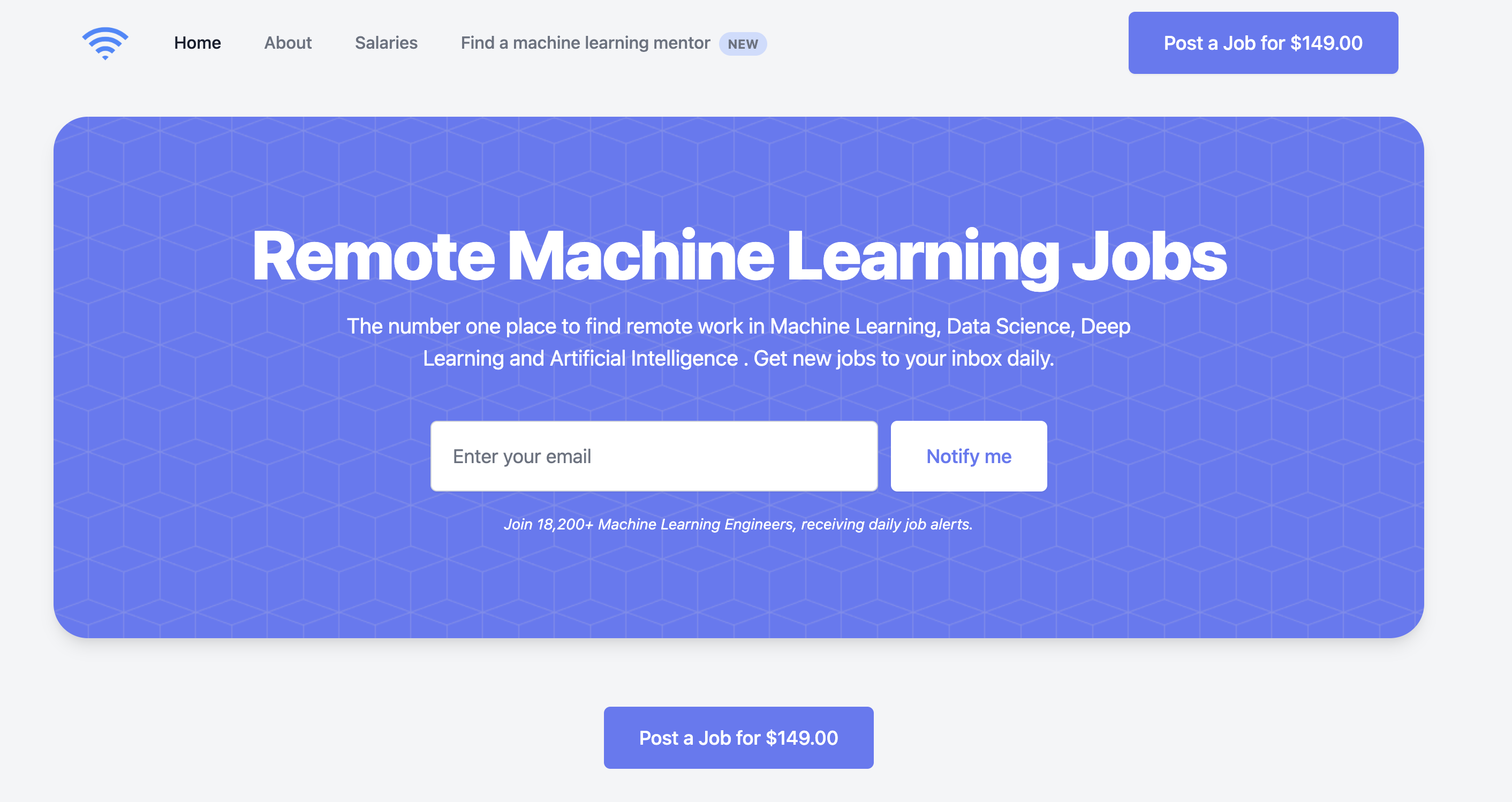
<p><img src="/assets/uploads/cleanshot-2022-05-06-at-17.14.03-2x.png" alt="" /></p>

<p>The search for my first full-time position in ML turned out to be more painful than I had thought. Local opportunities were limited, so I searched for more global opportunities.</p>

<p>With a painful search, I had managed to score a position at <a href="https://loomai.com/news">Loom.ai</a> but the search had motivated me to create a perpendicular offer to other remote job boards like <a href="https://remoteok.com/">https://remoteok.com/</a> which made it hard to filter for machine learning.</p>

<p>The site, being as niche as it is, had quickly become an authority in the space and has garnered over 18,000 subscribers and roughly $4,500 in revenue to this day.</p>

<p>I have tried to sell off the site a couple of times (including to one of the leading remote job boards of the world 👀) but was overall never pleased with how things were going.</p>

<p>To this day it’s mostly running on autopilot and provides some extra income here and there. It’s also a good lead generator for <a href="https://mentorcruise.com/filter/machinelearning/">MentorCruise’s machine learning mentors</a>.</p>

<h4 id="what-i-learned-from-this-3">What I learned from this</h4>

<p>The pros and cons from niching down. RemoteML keeps basically growing with the non-US machine learning industry itself.</p>

<p>The first time I had to deal with scale issues, e.g. how to send 10k+ emails in one go.</p>

<h2 id="focus-on-deep-tech">Focus on deep tech</h2>

<p>With some revenue-generating projects at my hand, I wanted to push the boundaries of what was possible as a solo maker. I also had acquired the skill of doing pretty much whatever I wanted with AI.</p>

<p>So these projects ended up making little to no money, but were fun experiences nevertheless! Since they were all fairly flashy, they were also the projects that ended up getting me meetings with interesting people, and got me into an early edition of the <a href="https://www.startupschool.org/">YC Startup School</a> and made me become a finalist of <a href="https://pioneer.app/">Pioneer</a>.</p>

<h3 id="hirnio--independent-research-into-bci-signals-2018-">Hirn.io – Independent research into BCI signals (2018) 🪦</h3>

<p><img src="/assets/uploads/cleanshot-2022-05-06-at-17.22.40-2x.png" alt="" /></p>

<p>Equipped with my fresh knowledge of Machine Learning and big data, I tried my skills at some Sci-Fi tech. I had purchased a consumer-grade <a href="https://www.emotiv.com/">EEG headset</a> and was reading out its signals to create small pieces of software, for example, to measure focus and even to create a “brain password”.</p>

<p>I had no goal to make money with this and also never did (quite the opposite). It was a fun experiment that got me in touch with a lot of smart people working on this underrated (and surprisingly underfunded) side of research. It taught me that there’s a lot more happening in the space, apart from Elon’s plans to implement chips in your brain.</p>

<p>Here’s some of my favourites:</p>

<ul>
  <li><a href="https://www.mindmaze.com/">MindMaze</a></li>
  <li><a href="https://www.kernel.com/">Kernel</a></li>
  <li><a href="https://venturebeat.com/2019/11/20/ctrl-labs-ceo-well-have-neural-interfaces-in-less-than-5-years/">CTRL Labs (bought by Meta)</a></li>
</ul>

<h4 id="what-i-learned-from-this-4">What I learned from this</h4>

<p>A bunch of obscure technical knowledge. What mattered more is the connections I’ve made with extremely bright people working in this space.</p>

<h3 id="adversary--ai-clothing-2019-">Adversary – AI clothing (2019) 🪦</h3>

<p><img src="/assets/uploads/cleanshot-2022-05-06-at-17.28.13-2x.png" alt="" /></p>

<p>In a very similar vibe, I started investing some of my time in AI-generated clothing. With the limited resources I had access to, I was able to generate a few interesting pieces of clothing and even ended up having a few calls with fashion designers and brands.</p>

<p>Many of them have gone on and invested more in space. Again, a very interesting experiment, but nothing I had the intention to make money with.</p>

<p>Some of my favorite things in this space:</p>

<ul>
  <li><a href="https://twitter.com/videodrome">Robbie Barrat’s work</a></li>
  <li><a href="https://www.instagram.com/electric_runway/">Electric Runway</a></li>
  <li><a href="https://twitter.com/tarynsouthern">Taryn Southern</a></li>
</ul>

<h4 id="what-i-learned-from-this-5">What I learned from this</h4>

<p>That there’s a niche for everything! As soon as I got into it, I had meeting lines up with AI fashion makers and investors. Crazy!</p>

<p>Also how hard it is to create a physical product. At some point I wanted to turn these into reality – really hard!</p>

<h3 id="best-of-ml--the-hacker-news-for-machine-learning-2019-">Best of ML – The Hacker News for Machine Learning (2019) 🪦</h3>

<p>As a branch-off from RemoteML, I tried to make a “Hacker News” for Machine Learning happen. It came out of the same frustration that I had when making RemoteML. The ecosystem was just small and slow!</p>

<p>Best of ML had a good initial launch and relaunch, but never got the traction it may have needed, I tried selling it, but the sale fell through. After this, Best of ML died a slow death.</p>

<h4 id="what-i-learned-from-this-6">What I learned from this</h4>

<p>Did a lot of scrapping work for this project. Also the acquisition was a mess. I learned to pick any business partners I work with carefully. This was a fail!</p>

<h2 id="back-to-making-money">Back to making money</h2>

<p>After a few failed launches and my previous revenue-generating projects making slow progress, I decided to get my head straight and try and score a home run. With what I had learned, I invested more resources in customer development, a proper marketing strategy, and a value proposition.</p>

<p>As a result, all of these had a good spark and were later sold or shut down as MentorCruise took off and overshadowed them.</p>

<h3 id="intravert--billboards-for-the-web-2019-">Intravert – Billboards for the web (2019) 💸</h3>

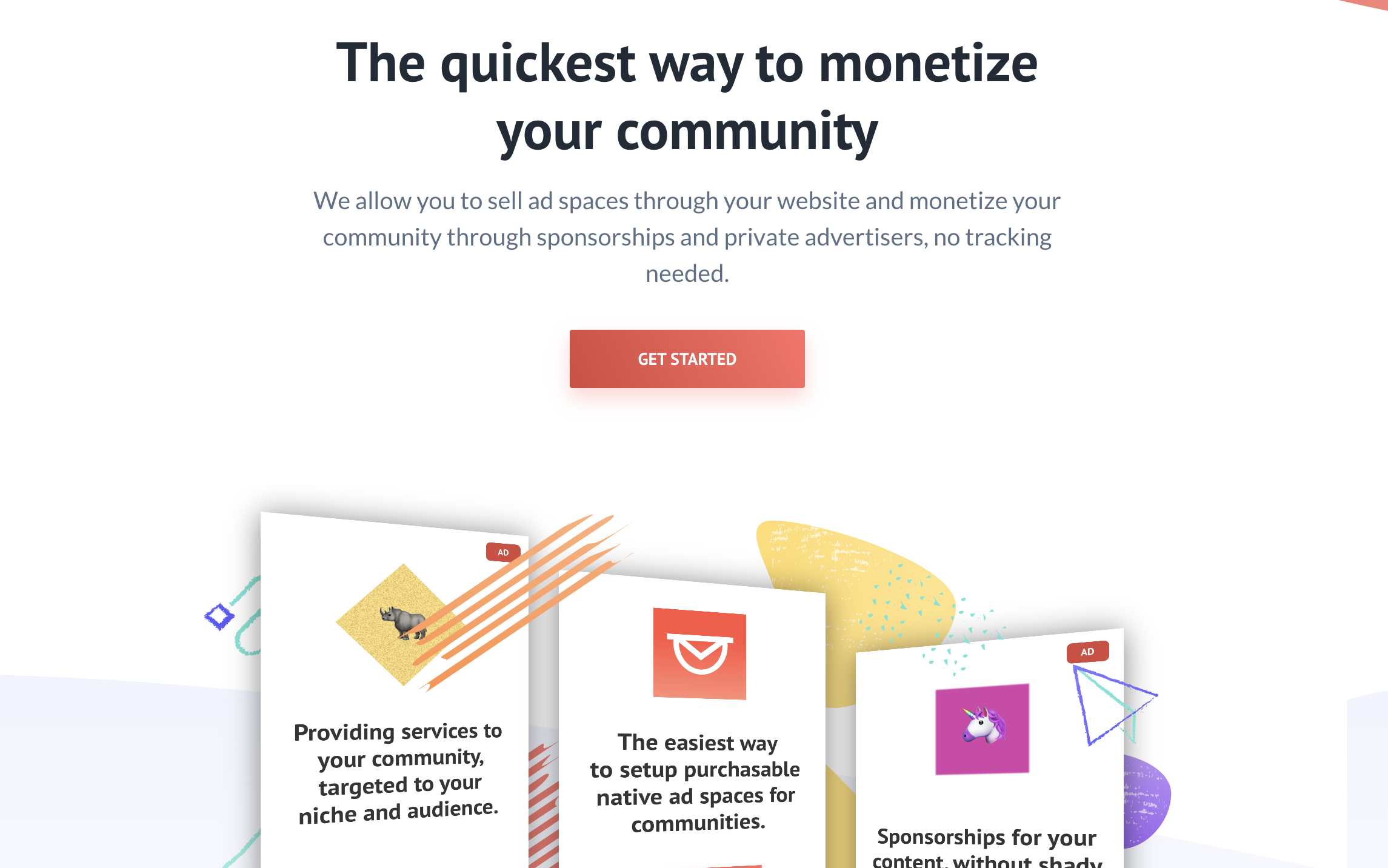
<p><img src="/assets/uploads/cleanshot-2022-05-06-at-17.49.55-2x.png" alt="" /></p>

<p>I made a bit of revenue with RemoteML, but it wasn’t groundbreaking. I sold sponsored job posts and also made some affiliate revenue from course websites.</p>

<p>When I started running ads on the website and ended up getting in about $5 with the traffic I had on the site, not worth it!</p>

<p>I placed a very generic “buy this ad spot” banner on the site and suddenly got a handful of requests to put a banner there for a month or two. I was able to charge $100s when previously I had only received $5! It occurred to me that niche traffic can be worth a lot, so built a way to sell banner ads on your site with <a href="https://intravert.co">Intravert</a>.</p>

<p>I asked a few friends with similar sites about the idea and a few of them, namely <a href="https://twitter.com/matteing">Sergio Mattei</a> who was owning Makerlog at that time, jumped at the thought of it!</p>

<p>I ended up building a nice checkout experience and way to serve the ads. Suddenly these smaller communities would make 3-4 figures in ad revenue, basically overnight!</p>

<p>However, the financial success of the app was hard. And even though Intravert communities had generated thousands in volume, the app itself was left with $200 in revenue. It would be an uphill battle!</p>

<p>After some attempts to SaaS-ify, I also sold this app for a four-figure sum. Looking back, I still like this idea. The new buyer(s) hasn’t pushed Intravert to the next level, but someone else definitely could.</p>

<h4 id="what-i-learned-from-this-7">What I learned from this</h4>

<p>First time I genuinely scratched a huge itch of mine and started seeing who else has the same itch. It also made me scared of commission businesses. On the wrong side of the medal, you’ll end up working for virtually nothing. If you do go that way, pick your commission structure wisely!</p>

<h3 id="remotehq--how-to-hire-remote-workers-2019-">RemoteHQ – How to hire remote workers (2019) 🪦</h3>

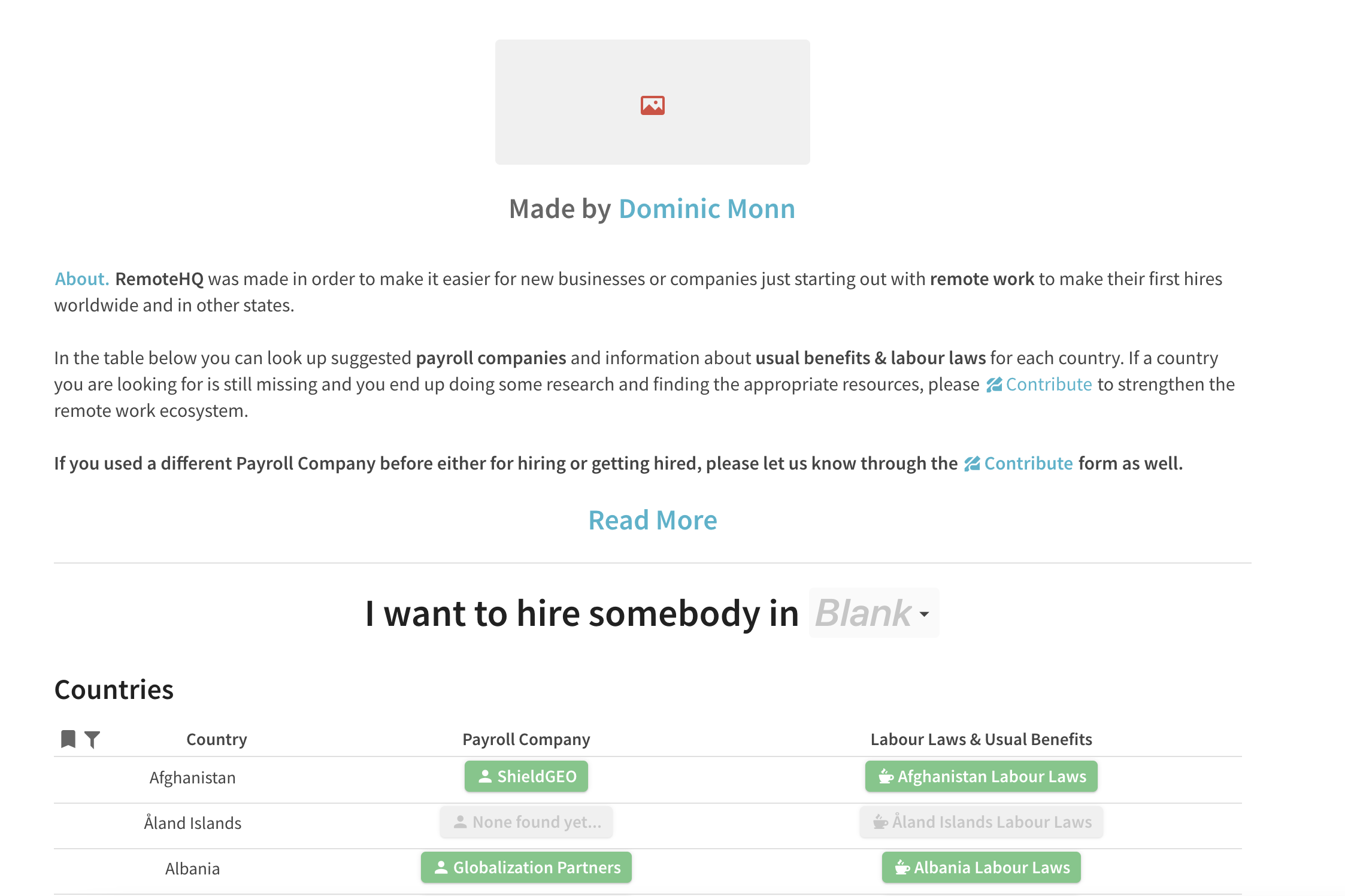
<p><img src="/assets/uploads/cleanshot-2022-05-06-at-17.56.30-2x.png" alt="" /></p>

<p>At my day job, we had a hard time hiring remote workers. Namely, it seemed impossible to find proper Employer of Record services whenever we wanted to hire from a new country.</p>

<p>For a ProductHunt hackathon, I created this no-code site of labor laws and EOR services and ended up coming third. Shortly after I found a naming clash with the lovely folks at <a href="https://remotehq.com/">RemoteHQ</a> so I sold them the domain and got them on board as a sponsor for my next project, right below 👇</p>

<h4 id="what-i-learned-from-this-8">What I learned from this</h4>

<p>Funny enough, some well-known companies like <a href="https://remote.com">Remote.com</a> and <a href="https://letsdeel.com">Deel</a> launched during this time. I had found a viable problem but built a non-viable solution for it.</p>

<h3 id="nohq--how-to-run-a-remote-team-2019-">NoHQ – How to run a remote team (2019) 💸</h3>

<p><img src="/assets/uploads/cleanshot-2022-05-06-at-17.59.52-2x.png" alt="" /></p>

<p>Not only did we have a hard time hiring remote workers, but we also experienced growing pains in <strong>running</strong> the thing. During this time I spent a lot of time reading best practice posts by places like <a href="https://gitlab.com">GitLab</a>, <a href="https://doist.com">Doist</a>, and others.</p>

<p>Somewhat unofficially I started writing about these issues that we were facing in short- to mid-form content, whereas a lot of others would publish “end-to-end guides” that took quite a bit to read. I had also started to send out the tips via newsletter.</p>

<p>What gave NoHQ the breakthrough was interviewing key people in remote work (I even scored <a href="https://nohq.co/blog/sid-sijbrandij-people-dont-want-to-commute-they-ju/">an interview with the CEO of GitLab</a>) and doing tool reviews.</p>

<p>The former gave the site a lot of relevance as it was not something that was usually done. The second attracted sponsors, big time, to the point where I was able to close $1,000+ in sponsorship money in some months.</p>

<p>In the end, the laborious nature of NoHQ made me lose the fun at it. And while it’s one of the projects I am most proud of, I also decided to let this one go to the talented <a href="https://twitter.com/nwitten">Neil Witten</a> who at the time was building his remote work empire.</p>

<p>This was my most lucrative sale up to this day and while I’m not comfortable sharing the exact number, it was a nice bolster on the savings and a kind compensation for the work that has gone into writing this much content.</p>

<h4 id="what-i-learned-from-this-9">What I learned from this</h4>

<p>Apart from MentorCruise, I learned the most from NoHQ. A blog is an opportunity to have a very raw experience in how to build traction, traffic, retain customers, do content marketing and SEO. Can only recommend!</p>

<h3 id="galilei--safety-tools-for-communities-2019-">Galilei – Safety tools for communities (2019) 💸</h3>

<p><img src="/assets/uploads/dfe23bbf703eecf67e90f08f4b59f5c0.webp" alt="" /></p>

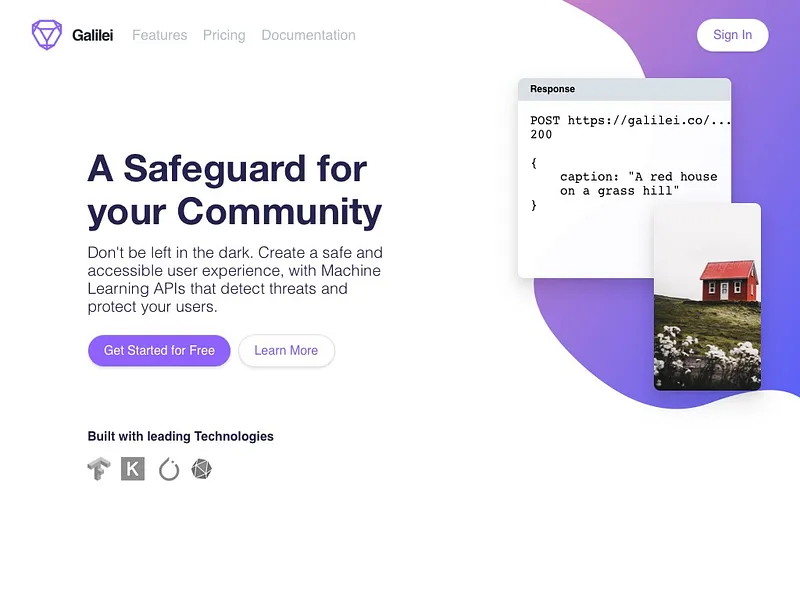
<p>This is a pretty short one. I was building a few machine learning models that would make life in communities easier. Things like a profanity detector and a NSFW image detector, which took me a couple of hours to build.</p>

<p>I built a Slack app around it and some APIs and must have posted the landing page somewhere because I got an acquisition offer of it from a streaming platform. I said yes, and my next sideproject never even properly launched!</p>

<h4 id="what-i-learned-from-this-10">What I learned from this</h4>

<p>First time I had the urge and need to do direct sales! When I sold, I had 4-5 leads open. This would come in extremely handy later once I started doing B2B sales with MentorCruise.</p>

<h3 id="payday--make-global-payouts-easy-2020-">Payday – Make global payouts easy (2020) 🪦</h3>

<p>If you’ve followed some of my writing, you know that as a marketplace founder, paying people all around the world is the <a href="https://twosided.io/p/the-global-payouts-and-marketplace?s=r">bane of my existence</a>. It’s a topic I’m passionate about and one I feel is still largely unsolved.</p>

<p>With Payday, I made an initial attempt at making it easier. Namely, it was a clean, free web app that made the bank information collection a lot smoother.</p>

<p>Then what most people don’t know – almost all countries have their little bank account formats. The US has an account number and routing number – easy enough. Much of Europe has an IBAN and potentially a BIC – cool! Of course except in some countries where you might have to add a national check digit too! What about India? Well, for one a full address is needed in most cases, and you’ll have to get some information about the bank branch. Brazil? Well, we’ll need a full ID first.</p>

<p>I was largely building this for myself and ended up shutting it down as it required continuous maintenance and I ended up working with another app that does this for me (thanks <a href="https://getborderless.com/">Borderless</a>).</p>

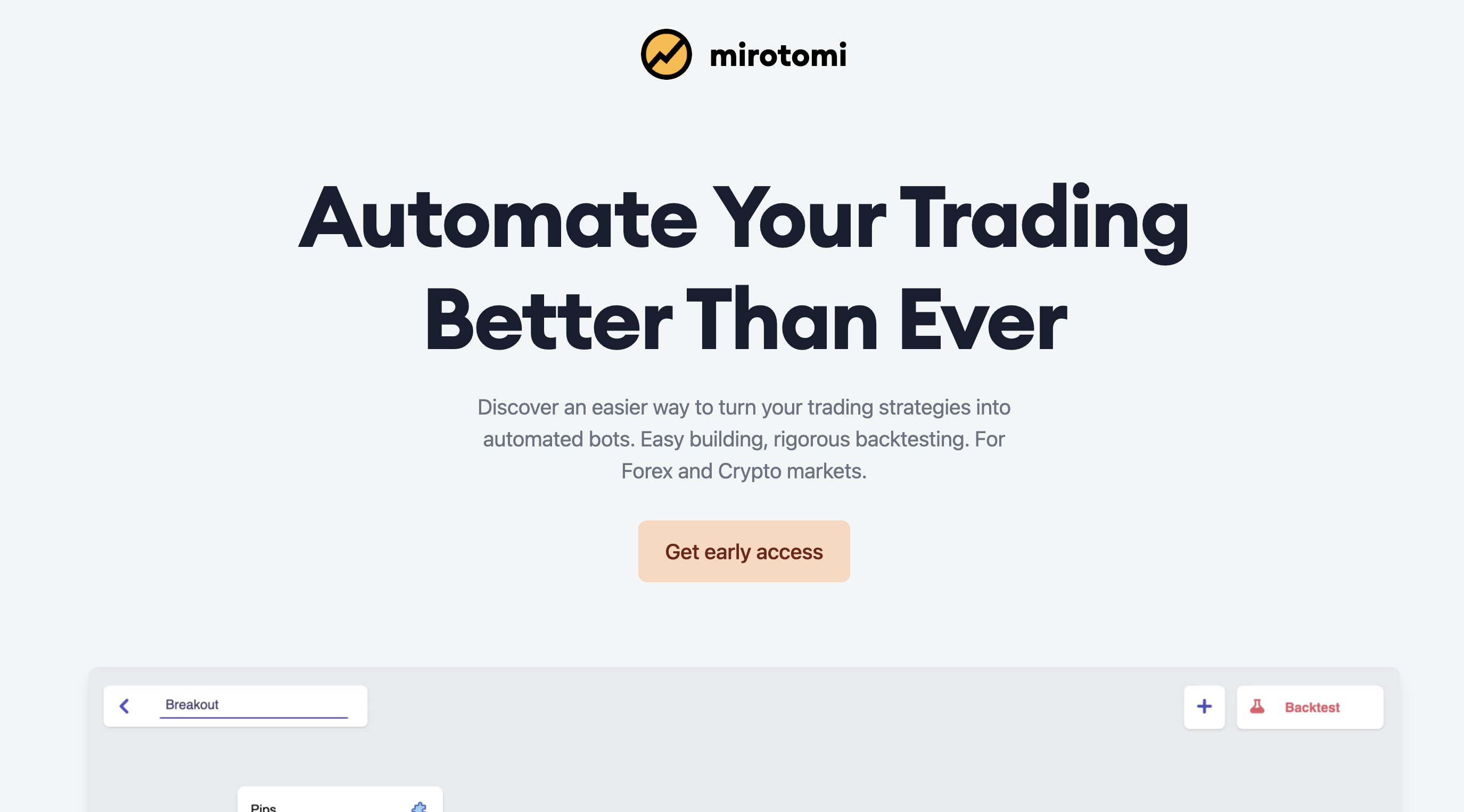
<h3 id="mirotomi--create-automated-trading-strategies-2020-">Mirotomi – Create automated trading strategies (2020) 🪦</h3>

<p><img src="/assets/uploads/cleanshot-2022-05-06-at-18.29.09-2x.png" alt="" /></p>

<p>My last one! 2020 was the height of self-proclaimed traders and stock gamblers. We were still about <a href="https://www.wsj.com/articles/reddits-wallstreetbets-was-the-gamestop-kingmaker-but-longtime-users-say-the-thrill-is-gone-11643025602">half a year away from Reddit taking over the stock market</a>, but the hype was there!</p>

<p>At the same time, I got a lot of mentees on my <a href="https://mentorcruise.com/mentor/DominicMonn/">MentorCruise profile</a> and the usual question I got was – “I have this idea / no idea, how can I build it?”. I had spent years soaking up the knowledge of how to run validation, and how to develop your customer. But with my projects, I mostly stumbled there with a good portion of luck.</p>

<p>With my new skills of building a business that by then was doing north of $4k per month, would I be able to launch something new?</p>

<p>I, too, was in the gold rush of retail investors and had a good bit of fun with <a href="https://en.wikipedia.org/wiki/Algorithmic_trading">algotrading</a>. But setting up algotrading was complicated and expensive. First, you had to get the data allowing you to test your algorithms, then you had to collect the knowledge to come up with one, build it and then also make sure you have a good testing infrastructure.</p>

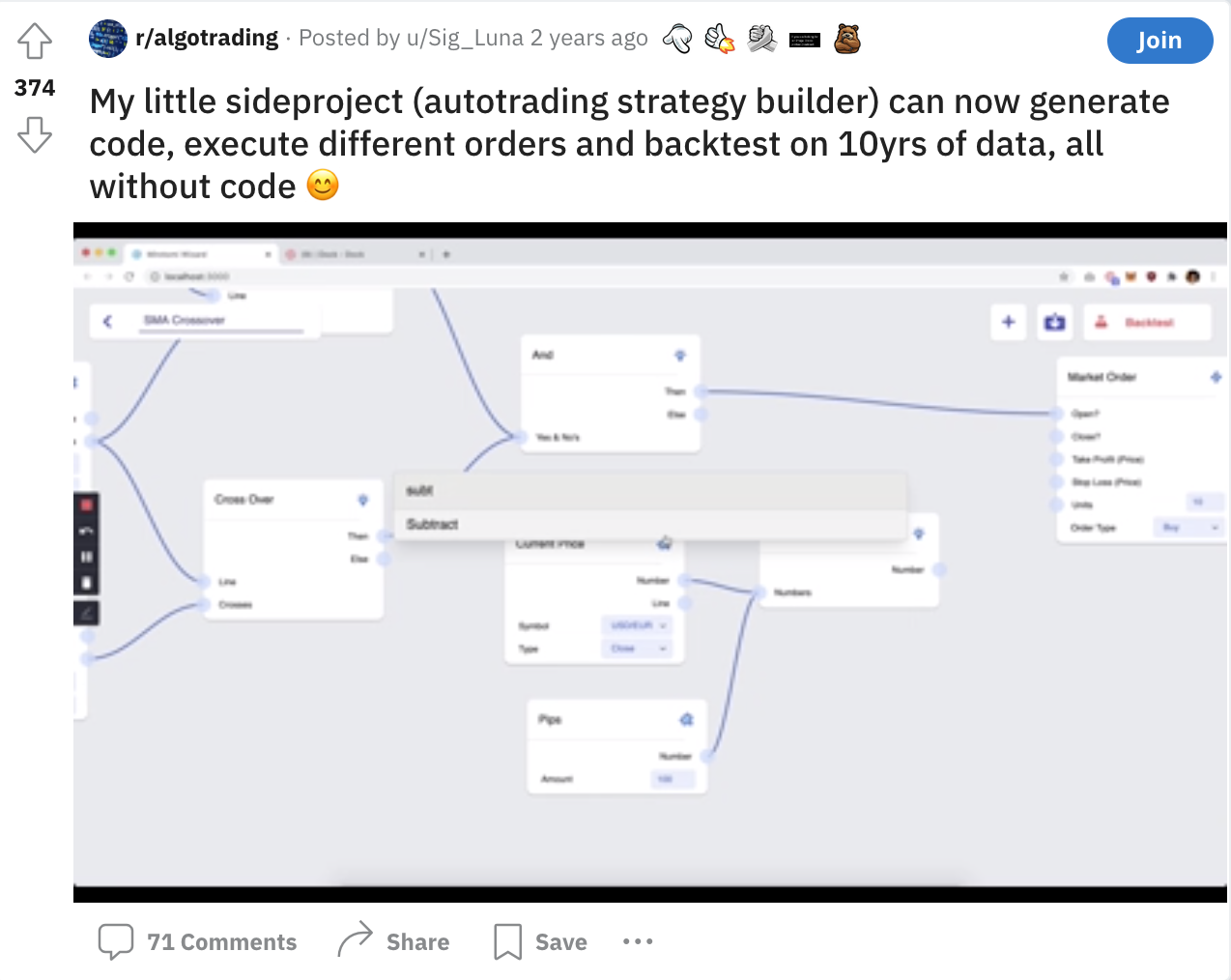
<p>I had found a problem and proposed a visual strategy builder as a solution for it. I built a demo in a day or two, recorded a video and the thing went semi-viral on Reddit.</p>

<p><img src="/assets/uploads/cleanshot-2022-05-06-at-18.51.08-2x.png" alt="" /></p>

<p>I put up a waiting list and without even posting the link to my project, suddenly had 250 people waiting for it. I built some more, recorded another video, went viral again, and suddenly had 500 people waiting for it. These people told their friends, which then told their friends – and there I was with a waitlist of over 1,000 people pinging me to finally get access to this thing.</p>

<p>I did end up having a functioning version of this at some point and did give it to a few people to try out. I am sure I could have turned this into a well-doing business, but I had little motivation to open another pandora’s box, the infrastructure was hard and heavy to keep up and it was not an audience I had fun serving, so I shut it down.</p>

<h4 id="what-i-learned-from-this-11">What I learned from this</h4>

<p>Flexed all my maker muscles for this one. Early validation, content marketing, a lot of technical bits I would have never dreamed of touching, especially when it comes to queues and big data caching.</p>

<p>A lot of this comes in handy even to this day. I also realized that in order to survive, you really need to love the audience you’ll serve. I didn’t for this one.</p>

<h2 id="conclusion">Conclusion</h2>

<p>You might be asking – what’s next? I for one am happy to be without a sideproject for now. The muscle still itches, but I’m plenty happy to grow MentorCruise to new heights.</p>

<p>If I am taking away one thing from this list, it’s that the sideprojects I’ve built have been a companion throughout my life and career. From trying to make it into the tech industry, to getting obsessed with Machine Learning and later topics like the creator economy and personal finance – my sideprojects are telling a story.</p>

<p>With my last sideprojects in 2020, there’ll be a little gap until this list grows some new items, though!</p>]]></content><author><name></name></author><summary type="html"><![CDATA[For most of my career, I've been the "sideproject guy" at work. Even for years before I even started working, my dream was to run my own business one day. Ever since then, I was hashing out ideas non-stop, from mobile apps to video games.]]></summary></entry><entry><title type="html">Metrics matter – even for tiny projects</title><link href="https://dmonn.com/metrics-matter-even-for-tiny-projects/" rel="alternate" type="text/html" title="Metrics matter – even for tiny projects" /><published>2020-02-10T08:26:43+00:00</published><updated>2020-02-10T08:26:43+00:00</updated><id>https://dmonn.com/metrics-matter-even-for-tiny-projects</id><content type="html" xml:base="https://dmonn.com/metrics-matter-even-for-tiny-projects/"><![CDATA[<p>At some point in 2018, YCombinator put ‘metrics’ engraved into my head in a Startup School lecture. I didn’t think much of it – my projects were growing a little bit after all and with a few thousand users were still so tiny that optimizing all that ‘big startup stuff’ didn’t make sense for me. Oh, how foolish.</p>

<p>Metrics are super important for startups, that much has been known for a long time. If you run a tight ship with a ton of employees, marketing efforts and a lot of money to be lost, you better make sure that your DAUs, MAUs, Churns and Funnels are in order to make the most out of everybody’s time, but why would I need that?</p>

<p>At some point, the growth that <a href="https://mentorcruise.com">MentorCruise</a> experienced wasn’t good enough for me anymore. In some months there was even negative growth – more folks left the platform than signed up, and my revenue went down. That’s heartbreaking to see, so I got behind those magical metrics to see what was going on.</p>

<h3 id="your-north-star-decides-what-you-work-on">Your north star decides what you work on</h3>

<p>Setting up metrics doesn’t really take a lot of time. For me, I looked up what some useful metrics are, built a little dashboard and some database queries and was done with it. I displayed trial mentorships, churn, funnels – all that good stuff. It’s a straightforward process that helps you tap around less in the dark, and is often the source you should take for prioritization.</p>

<p>In my case, I saw with shock that – while my churn metric at 5% was somewhat reasonable – my trial churn was at 25%. If you aren’t clear what that means: All that hard work I put into my product is only 75% effective (a lot less if you look at all other metrics, but you know…). I’m wasting energy and time and money, all because I didn’t want to be like the big companies who take it all so serious.</p>

<p>In some way, it was a really embarassing wake-up call. I was knees-deep into brainstorm how to get more traffic to the website, was churning out content like crazy, thinking about referral schemes and SEO – when 1/4 mentees left their mentor after the first week.</p>

<p>If you calculate your metrics, you should pick a north star and concentrate on it, plain and simple. In my case this was active mentorships. In order to optimize it, I had to <strong>improve acquisition</strong> and <strong>reduce churn</strong>. This has transformed my backlog from nifty little features that <em>I</em> wanted, to pain points and difficulties that my customers faced.</p>

<h3 id="optimization-for-the-tiny-ones">Optimization for the tiny ones</h3>

<p>I’m trying to keep advice here as general as possible, so I’m not going too much into the steps I took to bring down churn since then (spoiler: onboarding was a pretty big part). The next thing you should look at – and excuse this horrible marketing keyword – is your funnel.</p>

<p>Even if there is a whole science around it, a funnel is quite a simple thing. You pour things in at the top (called ‘leads’, but imagine it is everyone visiting your site or clicking ‘sign up’) and at the bottom comes out customers (or in other words $). A perfect funnel would turn every lead into a customer, but that’s rarely realistic. Every step it takes from visiting your site to giving you money is an opportunity to leave the site (or funnel).</p>

<p>In my case, my funnel was long. This was painful for me (because I lost a lot of people), but also painful for customers, because they <strong>want</strong> to give you money, but have a long way to go to get there. I initially used <a href="https://mixpanel.com/">Mixpanel</a> to visualize this, later switched to <a href="https://amplitude.com/">Aplitude</a> (friendlier pricing) and found that it takes a visitor on the site around 7 to 8 steps to even come close to give me money. At every step, some folks dropped out. I put effort into bringing people on the website, but what for?</p>

<p>If you are running a product, you should concentrate on the following (in this order).</p>

<ol>
  <li>Define north star metric</li>
  <li>Visualize funnel</li>
  <li>Improve funnel leaks</li>
  <li>Work on improving north star (e.g. paying customers)</li>
</ol>

<p>So, where are we today? Since doing this late last year, my trial churn went from 25% to around 18%. I shortened my acquisition funnel by combining multiple steps into one (e.g. you can now create a user while filling out an application), which improved the overall funnel throughput from something like 2.8% to 5%. That’s almost double!</p>

<p>There’s much more work to do, but with my metrics in hand I can test things out, see if they improve, and always know what to work on next.</p>]]></content><author><name></name></author><summary type="html"><![CDATA[At some point in 2018, YCombinator put ‘metrics’ engraved into my head in a Startup School lecture. I didn’t think much of it – my projects were growing a little bit after all and with a few thousand users were still so tiny that optimizing all that ‘big startup stuff’ didn’t make sense for me. Oh, how foolish.]]></summary></entry><entry><title type="html">Learnings from 2 years of building, owning and growing a product</title><link href="https://dmonn.com/learnings-from-2-years-of-building-owning-and-growing-a-product/" rel="alternate" type="text/html" title="Learnings from 2 years of building, owning and growing a product" /><published>2020-01-15T08:26:43+00:00</published><updated>2020-01-15T08:26:43+00:00</updated><id>https://dmonn.com/learnings-from-2-years-of-building-owning-and-growing-a-product</id><content type="html" xml:base="https://dmonn.com/learnings-from-2-years-of-building-owning-and-growing-a-product/"><![CDATA[<p>In March 2018 I released <a href="https://mentorcruise.com">MentorCruise</a>, a sideproject that has the goal to connect mentees with a helpful and longterm mentor in the tech industry. It didn’t go great at first, and it has easily been the #1 source of learning over the past few years. Let me share some of it for your journey building something new.</p>

<h3 id="building-a-product-start-tiny-and-with-no-assumptions">Building a product: Start tiny and with no assumptions</h3>

<p>You will see a pattern in this post that many of my learning come from mistakes. This is no exception. Looking back, my “MVP” was so overblown that it included functionalities I don’t even need today – and a lot that has been dropped since then.</p>

<p>I like nice, polished experiences. But functionalities are often not needed and can sometimes be solved manually with an e-mail. If you need more than a month to build the functionalities of your MVP, you might do too much. That’s generalising of course, but anything outside of your core experience is not needed for V1 and is slowing you down. If there’s a chance to kill it, do it.</p>

<p>So, what’s part of your core experience? What’s important is that you evaluate this without any assumptions and let your audience do the talking. You might see that many of the functionalities you thought are important are actually not valued.</p>

<h3 id="create-access-to-market-before-building-anything">Create access to market before building anything</h3>

<p>One core thing that made MentorCruise work out in the beginning was a good access to market: I knew tons of talented people on Twitter that would be up to join, and had access to a community of students through Udacity where I was initially allowed to post about the experience.</p>

<p>If you build a product today and your marketing and sales plans are Reddit and ProductHunt, just pause. I got a whopping 25 upvotes on ProductHunt and barely any traffic, even with my market access it took me two months until I got the first paying customer. Don’t underrate this!</p>

<p>If you’re remotely unsure about this, work on creating an opening in the market for yourself first. This can happen by either:</p>

<ul>
  <li>Joining communities of your target audience</li>
  <li>Cold emailing a ton of people</li>
  <li>Playing the long game and become a known figure in the niche</li>
  <li>Change the product to reflect a tiny niche in the market you were trying to address</li>
</ul>

<p>The most important thing pre-launch is feedback and proof of demand, the important thing post-launch is traction. You can get both by creating a good access to your market.</p>

<h3 id="sweat-the-little-things">Sweat the little things</h3>

<p>MentorCruise anno 2018 had a lot of issues. People didn’t understand the concept, were confused by the platform and disappointed by the experience.</p>

<p>Turns out, the experience was fine. A wise person told me (I have no idea who told me this, but feel free to claim the quote) “a good and a bad experience sometimes only differs based on expectations”, so I made sure to make the expectations clear.</p>

<p>Suddenly, all those complaints about pricing, the service and the platform were gone, so what did I do?</p>

<ul>
  <li>I created a proper onboarding sequence for new users, they should know what’s going on</li>
  <li>I worked with a copywriter to make it crystal clear how the service works</li>
  <li>I mention at several points what to expect from the service</li>
</ul>

<p>Did I care about my copy at the start? No. Did I even think about onboarding? No. Instead I created scheduling tools and management dashboards that barely get used. There will be things you don’t care about but your users might see everyday – get painfully aware of these areas and continously improve them.</p>

<h3 id="be-a-human-being">Be a human being</h3>

<p>Many businesses and platforms out there are horrible. What makes points today is humanity. Especially if you put your passion into a project, make your users feel it.</p>

<p>At the beginning I got the casual angry e-mail once in a while. It was often addressed at “Dear MentorCruise team” or “Dear Sir or Madam”, once I replied with my name and resolved issues quickly, things suddenly seemed not so bad anymore. A lot of people came back and thanked me. Some of them became year-long customers!</p>

<p>Part of that is handling customer requests like you’d want yours to be handled. That means:</p>

<ul>
  <li>Being easy about refund requests, there’s literally no sense in withholding a payment, unless you want a chargeback on your account.</li>
  <li>Reply with your name and be personal. If you work alone, don’t say “we will look into it”, say “I will take care of it, will come back to you asap”. Creates a lot of trust!</li>
  <li>Do your best, but explain if something is not possible for you to invest a lot of time in (e.g. a complicated issue, angry customer)</li>
</ul>

<h3 id="do-it">Do it!</h3>

<p>The last advice I can give you is to do it. Creating a product from scratch and running it is the best education you can get on the planet. If you are somewhat of a polymath and enjoy engineering, design, business, marketing, sales and more, this is what you need to do.</p>

<p>Apart from the learnings, it also helps you create something in the public eye. You might see people talking about your product in the wild, create value for someone, help somebody, and it’s all yours, so have fun with it.</p>]]></content><author><name></name></author><summary type="html"><![CDATA[In March 2018 I released MentorCruise, a sideproject that has the goal to connect mentees with a helpful and longterm mentor in the tech industry. It didn’t go great at first, and it has easily been the #1 source of learning over the past few years. Let me share some of it for your journey building something new.]]></summary></entry><entry><title type="html">Beyond Equity</title><link href="https://dmonn.com/beyond-equity/" rel="alternate" type="text/html" title="Beyond Equity" /><published>2019-02-13T08:26:43+00:00</published><updated>2019-02-13T08:26:43+00:00</updated><id>https://dmonn.com/beyond-equity</id><content type="html" xml:base="https://dmonn.com/beyond-equity/"><![CDATA[<p>The definition of startups is getting broader, and as <a href="https://indie.vc">founder-friendly VCs</a> are getting born, it might be time to think beyond equity.</p>

<p>Equity is loved and hated. For most startups, it is a substantial part of the compensation package and it’s usually the main vehicle to provide upside to employees and the founding team.</p>

<p>With about <a href="https://www.failory.com/blog/startup-failure-rate">90% of startups failing</a>, it can also be one of the most worthless / riskiest forms of compensation, so not everyone is open to it. Cash is still preferrable to many, leading to a team that is not sufficiently incentivized by the success of the overall company.</p>

<p>Even more so, many companies and their way of doing business are incompatible with issuing equity.</p>

<ul>
  <li>There is no exit in sight, so the equity can’t be sold (or at least not easily)</li>
  <li>The company is cautious when it comes to funding and growth, so equity isn’t worth a lot</li>
  <li>The founders prefer to own all/most equity in their own business</li>
  <li>It’s not possible or difficult due to the company structure (e.g. remote company in the US)</li>
</ul>

<p>Not only that, but giving equity in a successful business is also not a reward for loyalty or important work - it’s a reward for risk takers and people who can afford it. This creates an imbalance in the team, where impact is often disconnected from upside – companies are rewarding wealthier and more secure employees, not their most important ones.</p>

<h3 id="profit-sharing">Profit Sharing</h3>

<p>More companies are therefore looking into profit sharing as a way to reward loyalty and growth. Some of my favourite companies, such as Basecamp and Buffer, recently announced their Profit sharing programs.</p>

<figure class="kg-card kg-embed-card"><blockquote class="twitter-tweet">
<p lang="en" dir="ltr">Happy to share that to end 2018, Buffer is doing a profit share with our team of $394,997. We're also committing to doing charitable contributions matching 20% of this amount, so $78,999.<br /><br />Thread with details around our methodology for profit share and charitable contributions 👇</p>— Joel Gascoigne (@joelgascoigne) <a href="https://twitter.com/joelgascoigne/status/1074767019130535936?ref_src=twsrc%5Etfw">December 17, 2018</a>
</blockquote>
<script async="" src="https://platform.twitter.com/widgets.js" charset="utf-8"></script>
</figure>

<p>Profit sharing is an amazing way to reward employees:</p>

<ul>
  <li>It creates a liquidity event every year vs. possibly once every 10 years.</li>
  <li>It rewards productive work and loyalty vs. risk taking and luck</li>
  <li>It isn’t coupled with ownership</li>
</ul>

<p><strong>But what if</strong> there is an exit? Profit sharing can also include that, e.g. <a href="https://github.com/basecamp/handbook/blob/master/benefits-and-perks.md#employee-liquidity-pool">in form of a percentage of the company</a> that is distributed amongst all employees based on loyalty. Loyalty gets rewarded, employees are happy, founders are happy (because they get to keep a larger part of their own company!)</p>

<h3 id="addendum-in-2026">Addendum in 2026</h3>

<p>The trend of increasingly alternative ways of creating upsides for employees has continued over the years. In a world where big cash exits have gotten rarer, and companies have started surviving longer and pushing for profitability sooner, the development of this has continued.</p>

<p>Profit sharing remains at the core of many compensation strategies. In fact, it’s what we use at <a href="https://mentorcruise.com/">MentorCruise</a> as well.</p>

<p>However, I’ve also heard of teams that leverage the legal framework of equity to then pay out dividends or issue stock buybacks every few years. They’re also interesting compensation frameworks, all with their own pros and cons.</p>]]></content><author><name></name></author><summary type="html"><![CDATA[The definition of startups is getting broader, and as founder-friendly VCs are getting born, it might be time to think beyond equity.]]></summary></entry></feed>